
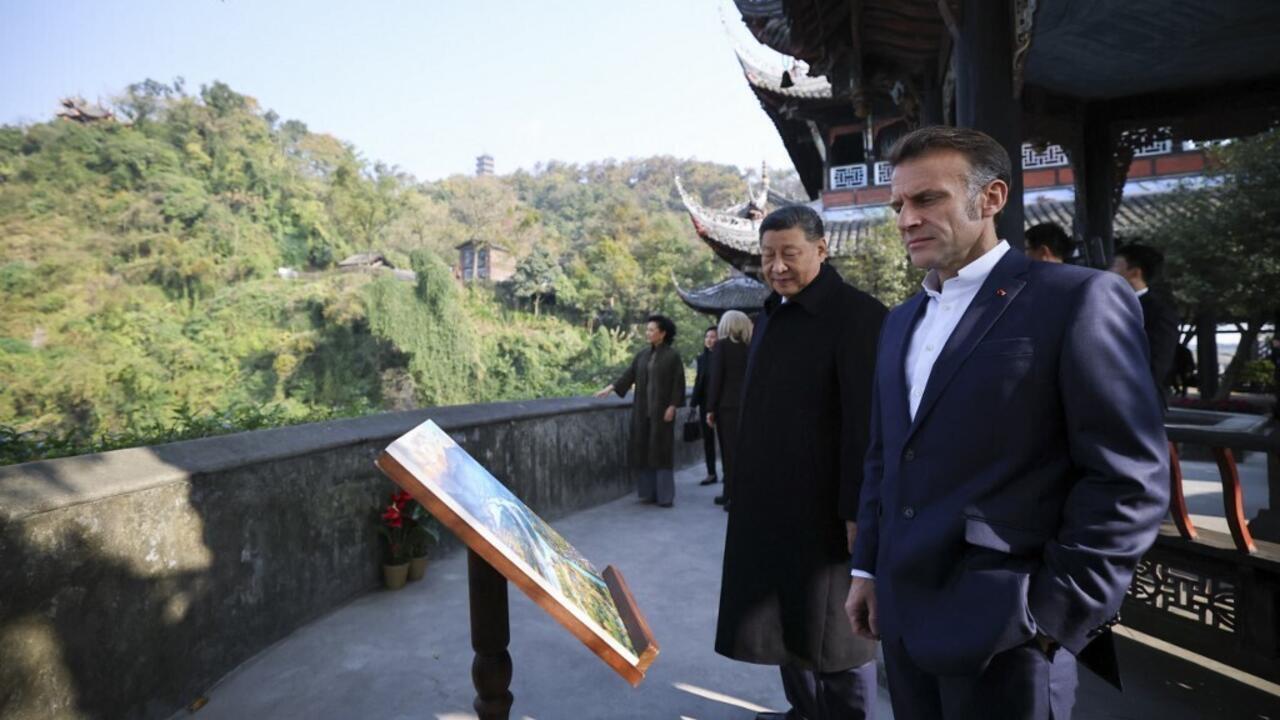
French President Emmanuel Macron concluded his state visit to China on Friday, December 5, 2025, engaging in extensive diplomatic and cultural exchanges, though direct geopolitical concessions from Chinese President Xi Jinping on issues such as the Russia-Ukraine conflict were not publicly announced.
The three-day visit, which spanned Beijing and Chengdu, underscored the complex and multifaceted nature of Sino-French relations, balancing France’s desire for China’s influence on global security with a shared interest in economic cooperation and cultural understanding. While the French delegation sought to leverage China’s sway in international affairs, particularly concerning the ongoing conflict in Ukraine, the visit ultimately highlighted Beijing’s consistent stance on sovereign decision-making and non-interference, alongside a robust commitment to deepening bilateral ties in other domains.
Macron’s Diplomatic Push and China’s Grand Welcome
President Macron’s primary objective for the visit was multifaceted: to encourage China to exert its influence to de-escalate the Russia-Ukraine conflict, to seek broader geopolitical understanding, and to explore avenues for France to benefit from China’s advancements in green technologies. The French delegation, including approximately 30 business executives, arrived with a clear agenda to strengthen economic partnerships and foster academic and research collaborations.
China, for its part, extended a high-level reception to the French President, signaling the importance Beijing places on its relationship with a key European Union member. The visit commenced on Thursday in Beijing with a grand welcoming ceremony, followed by extensive bilateral talks at the Great Hall of the People. These discussions covered a wide range of topics, from global security to economic cooperation. During this segment of the visit, twelve agreements and letters of intent were signed, encompassing areas such as research, university exchanges, nuclear energy cooperation, and cross-investments. While specific details of these agreements beyond their general scope were not immediately disclosed, they are understood to lay the groundwork for enhanced collaboration in critical sectors. The presence of French business leaders at the Sino-French Business Council meeting further emphasized the economic dimension of the visit, aiming to foster new commercial ties and investment opportunities.
However, the “arduous exchanges” on Ukraine and trade, as described by some sources, suggested underlying tensions despite the cordial atmosphere. France’s push for China to play a more active role in resolving the Russia-Ukraine conflict met with China’s consistent articulation of its position, which emphasizes dialogue and a political settlement while maintaining its strategic partnership with Russia. Similarly, discussions on trade likely touched upon existing points of contention between China and the European Union.
Chengdu Visit Fosters Personal Diplomacy and Cultural Exchange
The visit took a more intimate and relaxed turn on Friday, as President Macron traveled to Chengdu, the capital of Sichuan province, accompanied by President Xi Jinping. This gesture was notably rare, as President Xi seldom accompanies foreign delegations outside the capital, underscoring the special regard shown to President Macron. The shift from the formal settings of Beijing to the more relaxed environment of Chengdu was designed to continue the previous day’s “hard” exchanges in a less formal atmosphere, fostering a deeper personal connection between the two leaders.
In Chengdu, the two presidents visited the ancient Dujiangyan Irrigation System, a marvel of hydraulic engineering that dates back over two millennia. This visit provided a symbolic backdrop for discussions, highlighting enduring achievements and long-term vision. Following the tour, the two presidential couples shared a private lunch, further cementing the personal dimension of their interaction. While the specific content of their private conversations was not released, such informal settings are often conducive to franker and more in-depth discussions on sensitive issues.
Meanwhile, French First Lady Brigitte Macron engaged in a significant cultural exchange, visiting the Chengdu Research Base of Giant Panda Breeding. Her visit held particular symbolic weight as she reunited with Yuan Meng, the first giant panda born in France in 2017, for whom she is the godmother. Yuan Meng had returned to China in 2023. This event highlighted China’s “panda diplomacy,” where these iconic bears serve as goodwill ambassadors. Beijing also committed to sending new pandas to France’s Beauval Zoo, though specific details regarding the number, species, or timeline of these new arrivals were not immediately provided. This gesture reinforces the cultural bonds and mutual affection between the two nations, often seen as a softer, yet potent, aspect of diplomatic relations.
Complex Geopolitical Landscape and Trade Tensions
President Macron’s visit occurred against a backdrop of increasingly complex and at times strained relations between China and the European Union. Since Russia’s invasion of Ukraine, China’s continued support for Russia has been a significant point of friction, contributing to a perceived decline in Sino-European relations. European leaders, including President Macron, have repeatedly urged China to use its influence to press Russia for a peaceful resolution, a call that has largely been met with China’s emphasis on its independent foreign policy and calls for all parties to engage in dialogue.
Beyond geopolitical concerns, trade-related disputes have further exacerbated tensions. Issues such as rare earth magnets, Chinese batteries, electric vehicles, and the proliferation of small parcels in European markets have become new flashpoints. The European Union has expressed concerns about what it perceives as unfair trade practices and potential market distortions caused by Chinese subsidies and industrial policies. These economic grievances add another layer of complexity to the broader Sino-European relationship, making comprehensive agreements on sensitive issues more challenging.
The visit, therefore, served as a crucial opportunity for direct engagement between a key European leader and China’s head of state, allowing for candid discussions on these contentious issues. While France may not have secured the explicit geopolitical concessions it sought, the high-level dialogue and the signing of bilateral agreements indicate a mutual desire to manage disagreements and continue cooperation in areas of shared interest.
Historical Context of Sino-French Relations
Sino-French relations have a unique historical trajectory among Western powers. France was the first major Western country to establish diplomatic relations with the People’s Republic of China in 1964, under President Charles de Gaulle, a move that significantly impacted the global diplomatic landscape during the Cold War. This historical precedent has often been invoked to underscore a special relationship, characterized by a degree of strategic autonomy and a willingness to engage directly, even when other Western nations adopted more cautious approaches.
Over the decades, this relationship has seen periods of close cooperation, particularly in areas like nuclear energy, aerospace, and cultural exchange. High-level visits between leaders have been a consistent feature, often marked by significant economic deals and cultural initiatives. However, like any major bilateral relationship, it has also faced challenges, including human rights concerns, trade imbalances, and differing views on international affairs.
In recent years, as China’s global influence has grown and the international order has become more multipolar, France has sought to position itself as a bridge between China and the broader European Union, advocating for a balanced approach that combines engagement with a firm stance on European interests and values. President Macron’s visit can be seen as a continuation of this strategic orientation, aiming to maintain open channels of communication and cooperation while addressing points of divergence.
Looking Ahead: Navigating a Complex Future
President Macron’s visit to China, while not yielding immediate geopolitical breakthroughs on the Russia-Ukraine conflict, successfully reinforced bilateral ties through economic agreements and cultural exchanges. The high-level reception and President Xi’s rare accompaniment of a foreign leader outside Beijing underscored the strategic importance China places on its relationship with France. However, the underlying tensions related to the Russia-Ukraine conflict and ongoing trade disputes between China and the EU remain significant challenges.
The twelve agreements signed during the visit, covering research, education, nuclear energy, and cross-investments, indicate a commitment to deepening practical cooperation. The promise of new pandas for France further symbolizes the enduring cultural bonds. Yet, the absence of public announcements regarding geopolitical concessions suggests that China maintains its independent foreign policy stance, even in the face of strong appeals from European leaders.
As China and the European Union navigate an increasingly complex global landscape, characterized by geopolitical shifts and economic competition, the future of Sino-French relations will likely continue to be a delicate balance of cooperation and contention. Direct and high-level dialogues, such as President Macron’s recent visit, will remain crucial for managing expectations, addressing grievances, and identifying areas for mutual benefit, even as fundamental differences persist.
参考来源
- 马克龙访华受高规格接待,两国恐难在俄乌及台湾问题上“各取所需” — BBC Chinese(2025-12-05):查看原文
- Emmanuel Macron achève sa visite en Chine sans obtenir de concessions géopolitiques de Xi Jinping — RFI(2025-12-05):查看原文