
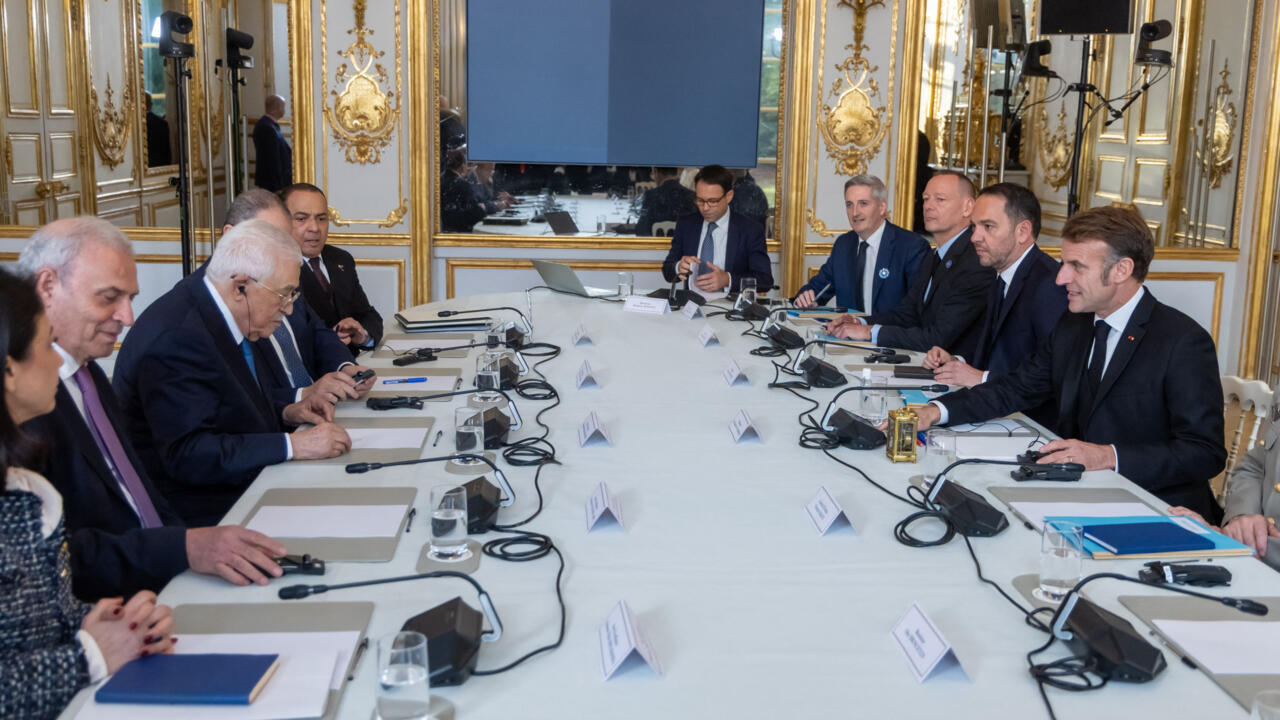
PARIS, France – French President Emmanuel Macron’s recent assertion that he has reviewed a preliminary draft of the Palestinian constitution has ignited widespread indignation among Palestinians, who view it as a blatant act of foreign interference and a form of “colonialism 2.0.” The controversy, which has been amplified across social media platforms, underscores deep-seated frustrations within Palestinian society regarding external influence and the legitimacy of their current leadership.
Macron’s Statement Ignites Palestinian Outcry
The current wave of protest was triggered by a statement made by President Macron on November 11, 2025, at the Élysée Palace in Paris. During a public address, Macron declared that he had seen an initial version of the Palestinian constitution. This revelation immediately drew sharp criticism from Palestinians, particularly younger generations, who expressed outrage that a foreign head of state would have access to such a foundational document before the Palestinian citizenry itself.
A video circulating widely on social media platforms captures a key moment contributing to the current discontent. In an excerpt from this video, dated October 13, 2025, President Macron is seen conversing with Palestinian Authority President Mahmoud Abbas in Egypt. During their exchange, the French president explicitly tells his Palestinian counterpart that he would call him once the constitution was received. This interaction, now viewed through the lens of Macron’s subsequent announcement, has fueled accusations of French overreach and a perceived lack of transparency in the constitutional drafting process.
Joint Committee Formed Amidst Constitutional Ambitions
The context for this constitutional endeavor emerged approximately fifteen days prior to the current article’s publication, around November 10, 2025. During a meeting at the Élysée Palace, President Macron and President Abbas announced the establishment of a joint committee. The stated purpose of this committee is to consolidate the Palestinian state and, crucially, to undertake the task of drafting a new constitution. This initiative was presented as a significant step towards strengthening Palestinian statehood, yet the subsequent events have cast a shadow over its reception among the very people it aims to serve.
However, details regarding the specific composition, terms of reference, and current progress of this joint committee remain largely undisclosed. It is also unclear whether the preliminary draft seen by President Macron was a product of this newly formed committee or an earlier iteration from another entity. Furthermore, the precise mechanism by which President Macron obtained this draft—whether through a formal submission by President Abbas or the committee—has not been clarified by either the French or Palestinian authorities.
Accusations of “Colonialism 2.0” and Undermining Sovereignty
For many Palestinians, especially the youth, President Macron’s premature access to the constitutional draft is not merely a diplomatic faux pas but a profound affront to their national dignity and sovereignty. Critics have vehemently labeled France’s actions as a form of “colonialism 2.0,” arguing that it represents an unacceptable intervention in their internal affairs. They contend that for the French president to review their constitution before any Palestinian citizen, save for those in President Abbas’s immediate circle, is an insult to the Palestinian people’s right to self-determination.
This sentiment is deeply intertwined with widespread disillusionment regarding the legitimacy of President Abbas’s leadership. Mahmoud Abbas was elected president in 2005 for a four-year term. However, new elections have not been held since, meaning his mandate officially expired over 16 years ago. Most young Palestinians perceive Abbas as corrupt, overly lenient towards Israel, apathetic to their daily struggles, and fundamentally undemocratic. They accuse him of deliberately avoiding new elections to maintain his grip on power. Against this backdrop, French engagement with Abbas on such a sensitive issue as the constitution is seen by many as an endorsement of an unelected leader and a further entrenchment of a system they view as illegitimate.
Some Palestinians have gone further, accusing President Macron of attempting to silence Palestinian voices and viewing the entire initiative as a “political show.” They argue that such actions are designed primarily “to further fragment the Palestinian people and to deprive them of their rights,” rather than genuinely supporting their aspirations for statehood.
France’s Historical Role and Regional Dynamics
France has historically played a significant role in the Middle East, often positioning itself as a mediator and advocate for a two-state solution in the Israeli-Palestinian conflict. Its diplomatic efforts have frequently sought to balance relations with both Israel and the Palestinian Authority, while also asserting its influence as a major European power. The current controversy, however, risks undermining France’s credibility among a significant segment of the Palestinian population and could complicate its future diplomatic endeavors in the region.
The incident also highlights the complex and often fraught relationship between external powers and the internal political processes of nascent or contested states. While international support is often crucial for state-building efforts, the manner in which such support is rendered can inadvertently trigger accusations of interference, particularly when domestic political legitimacy is already under scrutiny. The absence of a clear, unified Palestinian voice on the constitutional process, coupled with the long-standing internal divisions between Fatah and Hamas, further complicates any external engagement.
Unanswered Questions and Future Implications
As of November 25, 2025, several critical questions remain unanswered. The specific content of the constitutional draft seen by President Macron has not been disclosed, leaving Palestinians to speculate about its provisions and potential implications for their future state. Neither the French government nor President Abbas has issued an official response to the widespread Palestinian protests and accusations of interference. Similarly, the international community’s reaction to this specific incident has not been widely reported.
The ongoing controversy poses significant challenges for the future of the French-Palestinian relationship and the broader efforts to consolidate the Palestinian state. For France, it risks alienating a crucial demographic within Palestinian society and could be perceived as undermining its stated commitment to Palestinian self-determination. For the Palestinian Authority, it exacerbates existing legitimacy issues and deepens the divide between the leadership and a disillusioned populace. The incident underscores the delicate balance required in international diplomacy, particularly when engaging with sensitive national processes like constitutional reform in a region as politically charged as Palestine.
参考来源
- Des Palestiniens s'insurgent que Macron ait pu avoir accès à une première version de la Constitution — RFI(2025-11-25):查看原文